Industrial Furnace Exhaust Gas Recovery for Nitrogen, Hydrogen and Argon
Your annealing furnace pays to protect the strip, then vents most of that expensive gas up the stack. We put it back in the furnace. Hydrogen recovery alone saves 50-85% of protective gas consumption on roller hearth, bell, pit and pusher line duties.
Product gallery
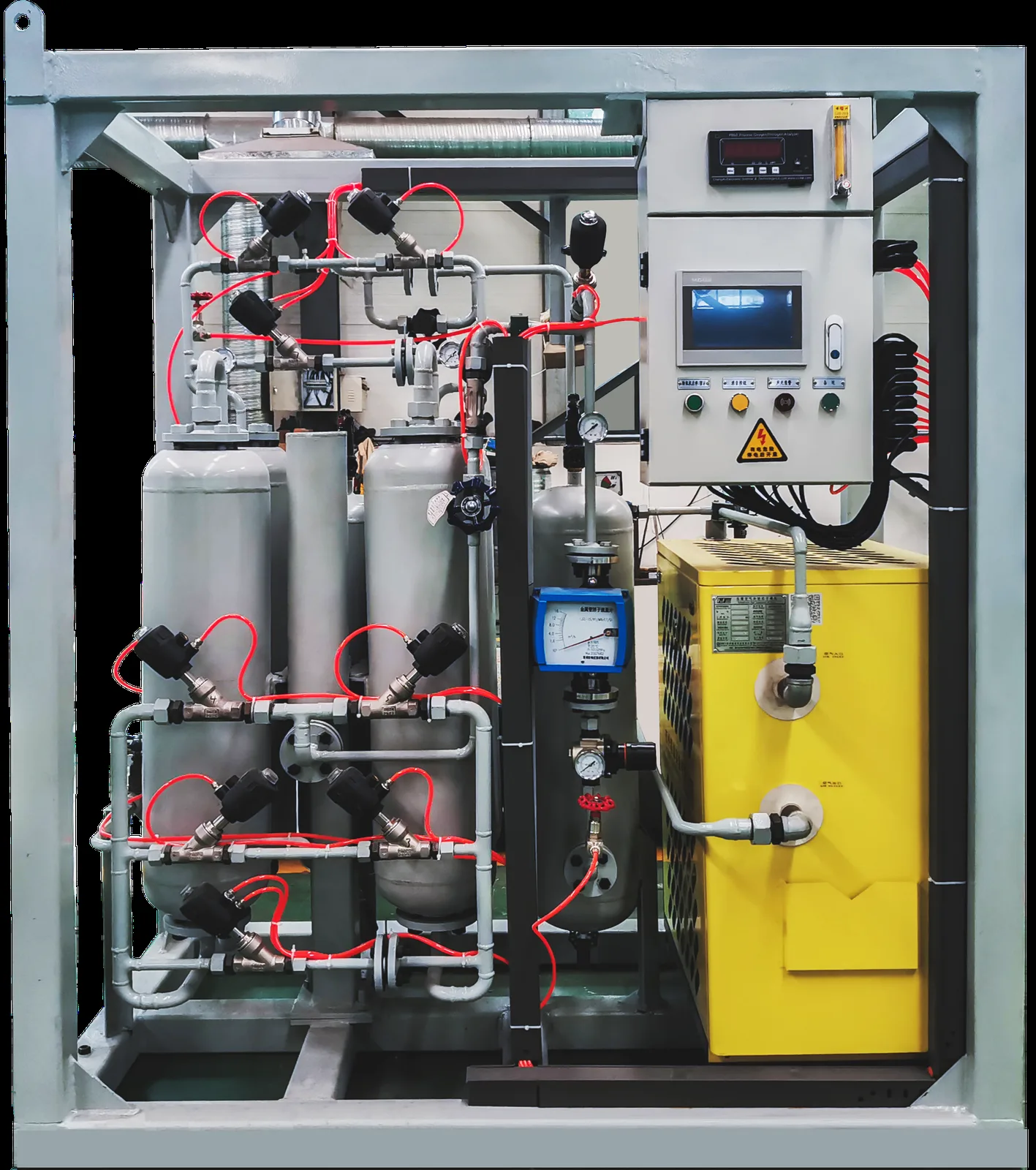
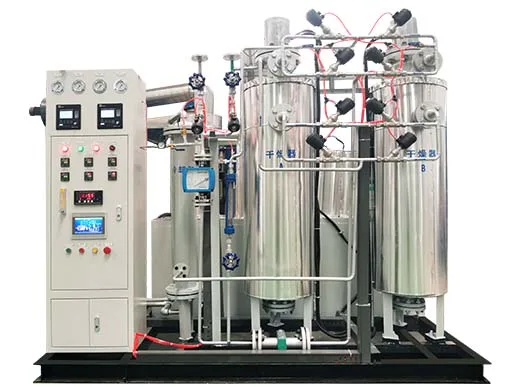
The Invisible Line Item on Your Furnace Bill
Nitrogen and argon go into an annealing furnace as inert atmosphere, never react, and leave as stack gas - vented or flared, still as pure as the day they were metered in. Hydrogen does the same while costing per cubic meter several times over, in mixtures on stainless and copper lines where it's the largest single gas budget on the site. Every furnace we've surveyed wastes one; every recovery skid we've built has made that waste a purchasing decision instead of an accident.
How the Recovery Loop Works
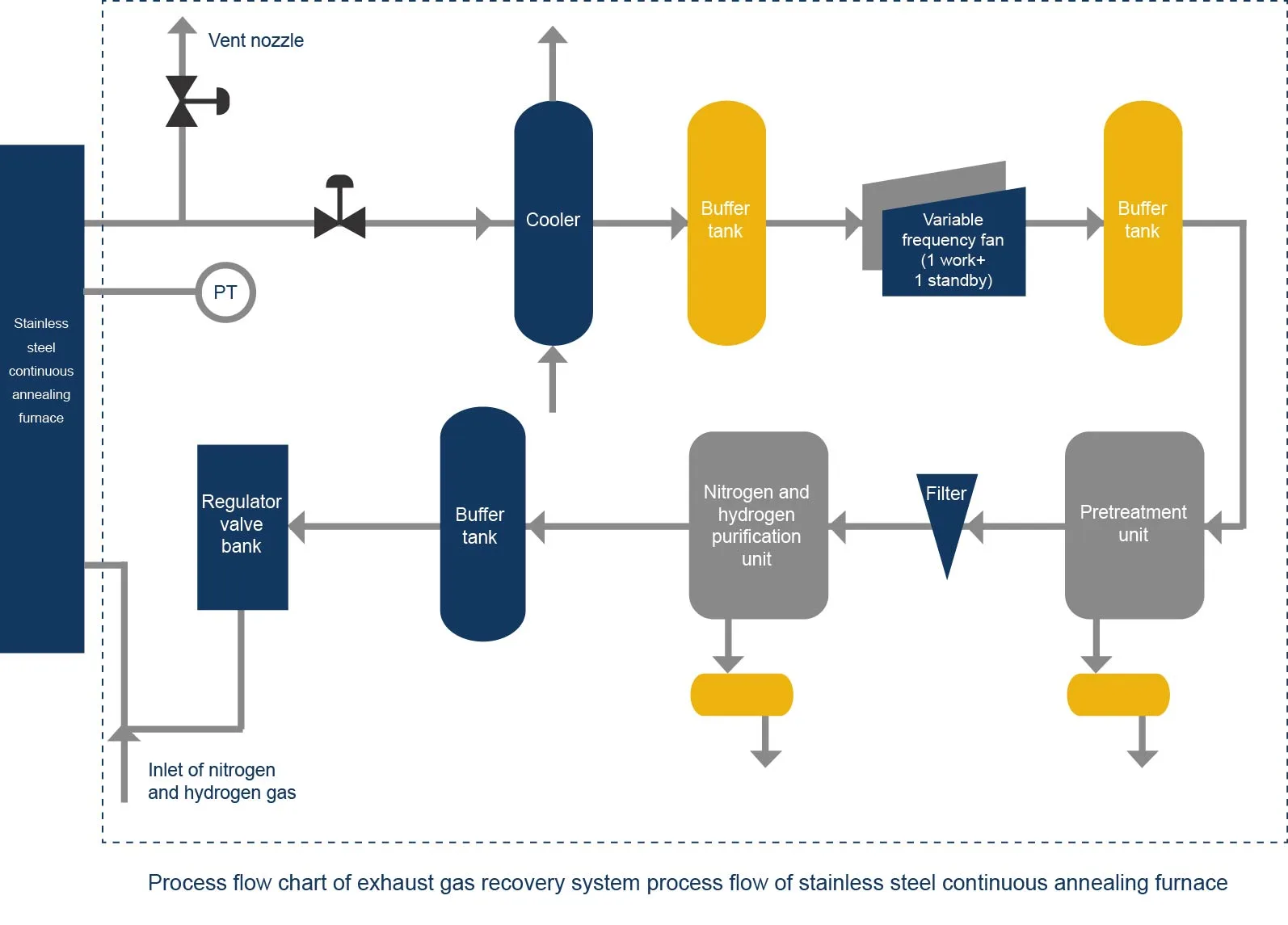
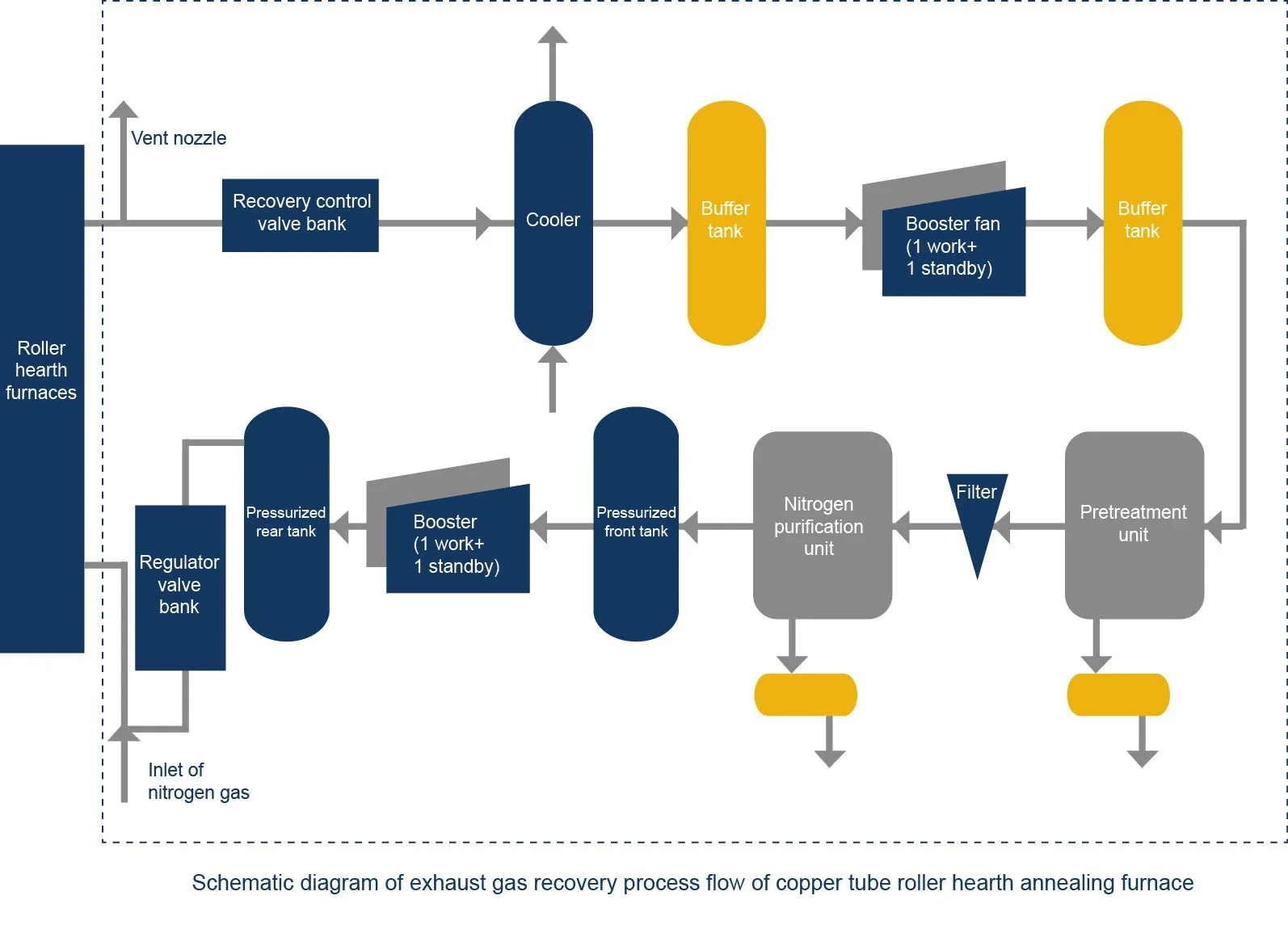
Furnace off-gas is captured at the outlet, cooled, dedusted, and passed through a separation train - the classic hydrogen recovery route scrubs and compresses, rejects a small purge, and returns the recovered stream to the furnace inlet header under pressure control. Control logic keeps the furnace atmosphere spec constant no matter what the recovery loop is doing; make-up gas tops off the difference. Fail-safe logic dumps to the original vent path if recovery goes offline - the furnace never notices, the savings pause.
Three Furnace Families We Engineer Against
Nitrogen recovery: continuous withdrawal, roller hearth, bell, pit, pusher and trolley furnaces running N₂ protective atmosphere. Hydrogen recovery: bell-furnace and continuous-furnace configurations, each with low-hydrogen, high-hydrogen and full-hydrogen variants sorted by the inlet H₂ percentage of your atmosphere. Argon recovery: custom-designed against your process because argon's rarity makes every loss a pricing conversation, not a rounding error.
What the Numbers Mean on Your Meter
Published range first, then the honesty: 50-85% hydrogen consumption reduction is what these systems deliver across the furnace types above; the position in that range is set by inlet purity, cycle profile and how much make-up your spec tolerates. A good feasibility pass needs four things from you - furnace type, atmosphere mix, daily gas bills and a plot plan - and returns a payback in months, not a brochure. We've written the copper-tube roller-hearth and stainless continuous-annealing flowsheets enough times to know the deviations before commissioning.
Why a Gas-Plant Builder Does This Better Than a Generic Integrator
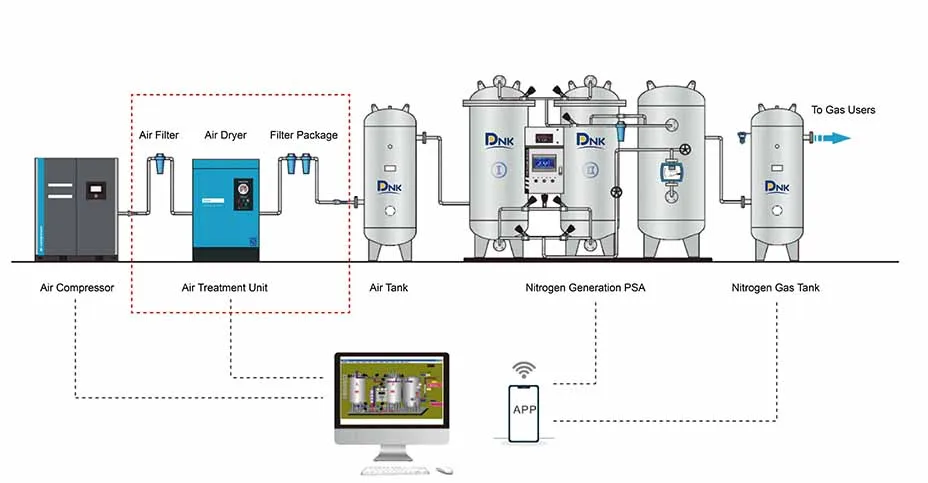
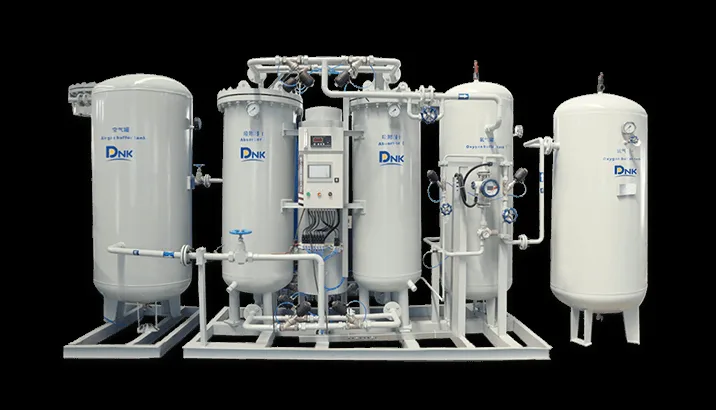
Recovery is separation engineering wearing a furnace's clothes: what fraction can be recovered, at what purity, with what compressor duty, is air-separation physics. The team that designs cold boxes and PSA towers designs these trains on the same process software, built on the same pressure-vessel licenses, serviced by the same desk. Which is also the argument for pairing a recovery skid with a DINAK nitrogen or hydrogen source - one warranty boundary across the whole gas loop instead of three fingers pointing at commissioning.
FAQ
Does recovery hurt furnace atmosphere quality?
No, by design. The recovered gas returns through a control and make-up blending package that maintains your atmosphere spec; interlocks keep recovery in a follower role. A failed recovery loop is a paused savings account, never a scrapped furnace charge.
Can one skid serve multiple furnaces?
When furnace cycles are staggered and gas specs are close, a shared header and one larger train often beat one-skid-per-furnace. The feasibility pass prices both schemes so the schedule decides with numbers.
What about oxygen and moisture ingress in recovered gas?
Off-gas picks up trace O₂ and H₂O at furnace openings; the train includes purification beds sized for that load, monitored by analyzers on the return header. Residual specs are part of the proposal, because argon or hydrogen returned out of spec is just expensive diluent.
How do you handle safety review for hydrogen plants?
Hydrogen duty follows your jurisdiction's codes with ATEX-classed electrics, flame arrestors, venting and gas detection as designed scope, not options. We've commissioned these systems in China and internationally; the safety documentation package is as much a deliverable as the skid.
The Gas You Pay For Is Leaving Through The Stack
An annealing furnace protects its metal with a blanket of nitrogen, hydrogen or argon - expensive manufactured gas that flows through the workload, picks up heat and furnace atmosphere, and leaves through the relief stack because that is cheaper than cleaning and re-compressing it. For a generation of plant managers, "cheaper" was an illusion measured in the gas bill rather than the ledger.
A recovery system reverses that math. The exhaust that used to leave at atmosphere pressure gets captured, cooled, scrubbed, compressed, purified and pushed back into the furnace loop. The verified saving our installed base sees against once-through supply: 50% to 85% of protection-gas consumption, which on a full-hydrogen annealing line is a business-line number, not a rounding line.
The three furnace families we build for, because each has a distinct gas story:
- Low-hydrogen duty - nitrogen-dominant blanket with a small H₂ fraction. The recovery loop is mostly nitrogen logistics: compression, purification, re-injection, with the hydrogen slip managed.
- High-hydrogen duty - the hydrogen share gets big enough that recovery turns into a hydrogen business: rated compression, rated storage, rated everything. This is where the system's engineering and its price both live up.
- Full-hydrogen duty - no nitrogen makeup habit, the atmosphere is the product, and recovery efficiency is the whole ROI argument.
Argon recovery systems serve the stainless and special-alloy lines where argon partial pressures make the once-through bill genuinely painful.
What Happens Between The Stack And The Furnace Inlet
The train is a sequence of six stations, each solving one physical problem:
- Capture and cool. Exhaust leaves hot; the cooler drops it to a temperature the downstream hardware can survive and condenses the water and oil mist load there where it is cheap to remove.
- Clean. Multi-stage filtration catches the particulate and hydrocarbon that would otherwise poison the compressor and the purification beds. furnace exhaust is dirtier than any datasheet admits on day one.
- Concentrate. Where the process gas needs upgrading rather than mere cleaning - nitrogen from mixed exhaust, hydrogen separation on the high-H₂ duties - the separation train does it.
- Compress. This is where our own reciprocating compressor line goes to work; the machine is native to these suction/discharge duties because we sized it for air-gas service in the first place.
- Store. Buffer vessels decouple the furnace's pulsing demand from the recovery system's steady rhythm - without them the compressors cycle like mad and die young.
- Re-inject with control. PLC ratio control returns the recovered gas at the atmosphere setpoint the furnace metallurgy needs, with safety interlocks on hydrogen fraction and oxygen ingress that are non-negotiable on annealing lines.
Making The Business Case, Then Making It Real
The ROI conversation needs four numbers from your plant: annual protection-gas purchases for the furnace line, furnace duty hours, the atmosphere type (low-H, high-H, full-H), and the maintenance money the dust and heat currently cost you. Systems sized on those four show their strongest case on full-hydrogen lines, where the 50-85% gas saving dominates the capital; low-hydrogen lines run a longer payback that should still be positive before you sign.
Installation runs in live-plant conditions by design: the recovery loop ties into the furnace exhaust manifold and the gas supply header, commissioning is phased so one furnace at a time transitions from vent-and-replace to closed-loop, and the ratio-control tuning is validated against the metallurgy team's atmosphere spec. We have executed this work on batch bell lines and continuous annealing lines across both steel majors and mid-size wire and special-alloy shops.
Send your gas invoices for the furnace line - twelve months of them - and the feasibility study comes back as your own numbers with a saving band you can audit line by line. If the arithmetic says the recovery doesn't pay on your duty pattern, we say so; overselling a recovery system to a plant that should just buy cheaper gas is how the rest of this industry got its reputation.
Specifying The Recovery System: Our Site Study
Recovery systems are not catalog machines - the furnace defines the duty and the duty defines the machine. Our site study walks your line and answers six questions before a number is ever quoted:
- What actually comes out of the stack? Flow, composition, temperature and particulate measured on a normal production day, not nameplate assumptions - exhaust gas analysis is where the design starts.
- What does the furnace need back? Atmosphere composition and pressure tolerance from your metallurgy team; a recovery loop that cannot return the right mixture is an expensive recirculation of the wrong argument.
- How much make-up stays anyway? Recovery is 50-85%, never 100% - the honest numbers include the fresh-gas header that remains, and the control design keeps both supplies honest.
- Where does the hydrogen risk live? Storage sizing, venting, detection and area classification for H₂ duties, designed to your code - reviewed with your safety officer before it is reviewed with procurement.
- What breaks, and how fast? Filters clog, compressors need valve kits, coolers foul - so the maintenance access, spare kit and service calendar are designed into the plot plan at the same time as the pipe racks.
- What is the metering truth? Custody meters on fresh gas and recovered loops from commissioning day, so the saving your finance team reports is measured by instruments rather than by vibes.
Send the gas invoices and a furnace-line description; the feasibility study comes back sized against your own records, with the honest saving band, the risk picture and the capital - and if the arithmetic is thin, the study says so in the first paragraph.
Related Equipment
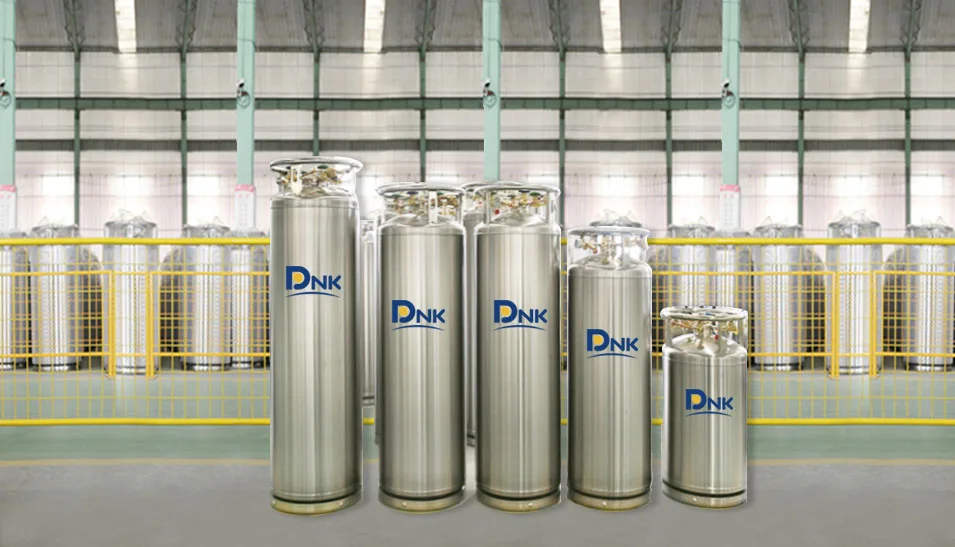
Welded Insulated Cylinders
The pickup-truck-sized thermos that turned micro-bulk into an industry
Learn more →
Get a Quote From the Factory
Tell us your flow, purity and pressure - an engineer replies within 24 hours.
Send Your Requirement
Flow, purity, pressure and application - four numbers are enough to start.